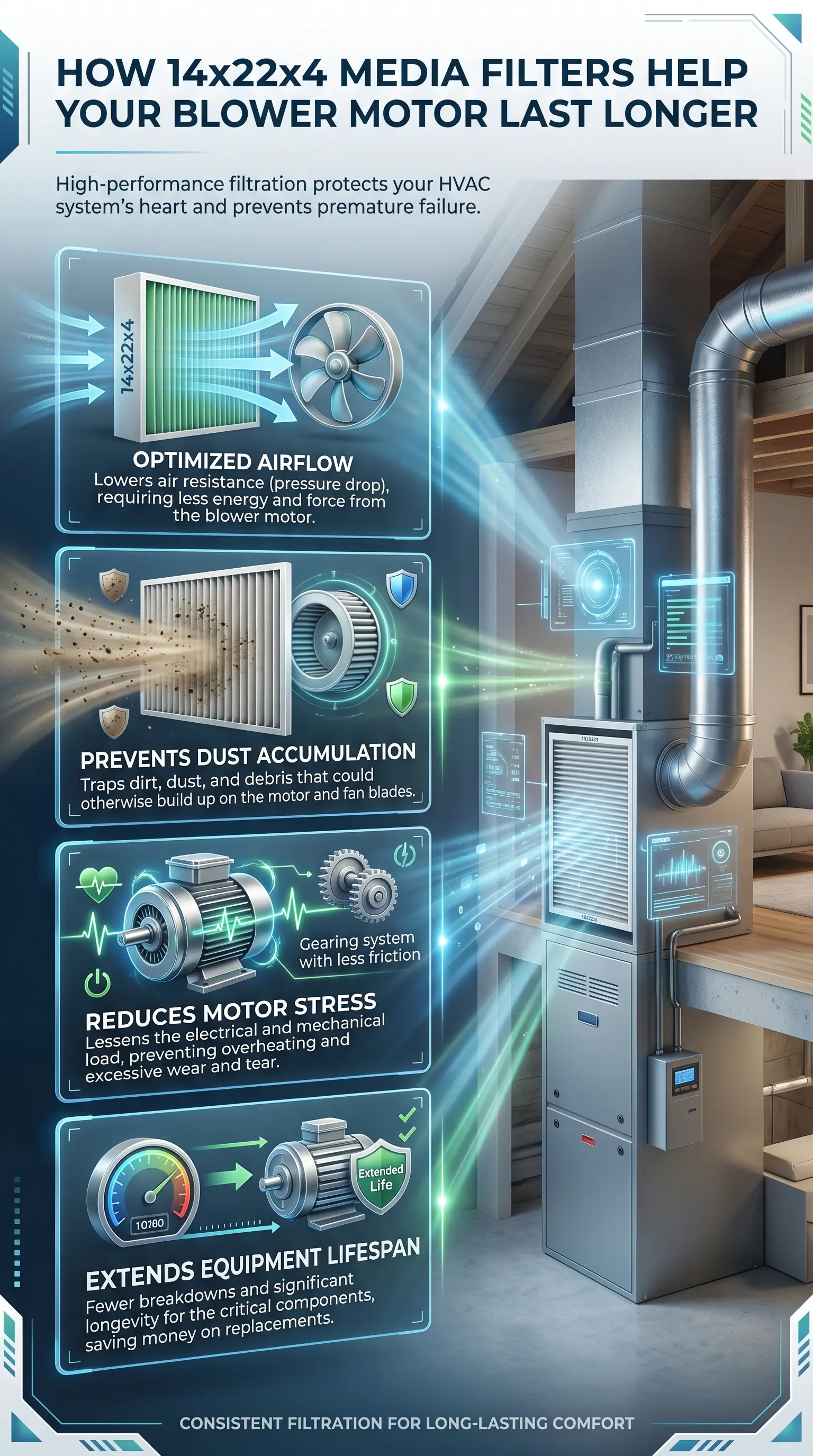
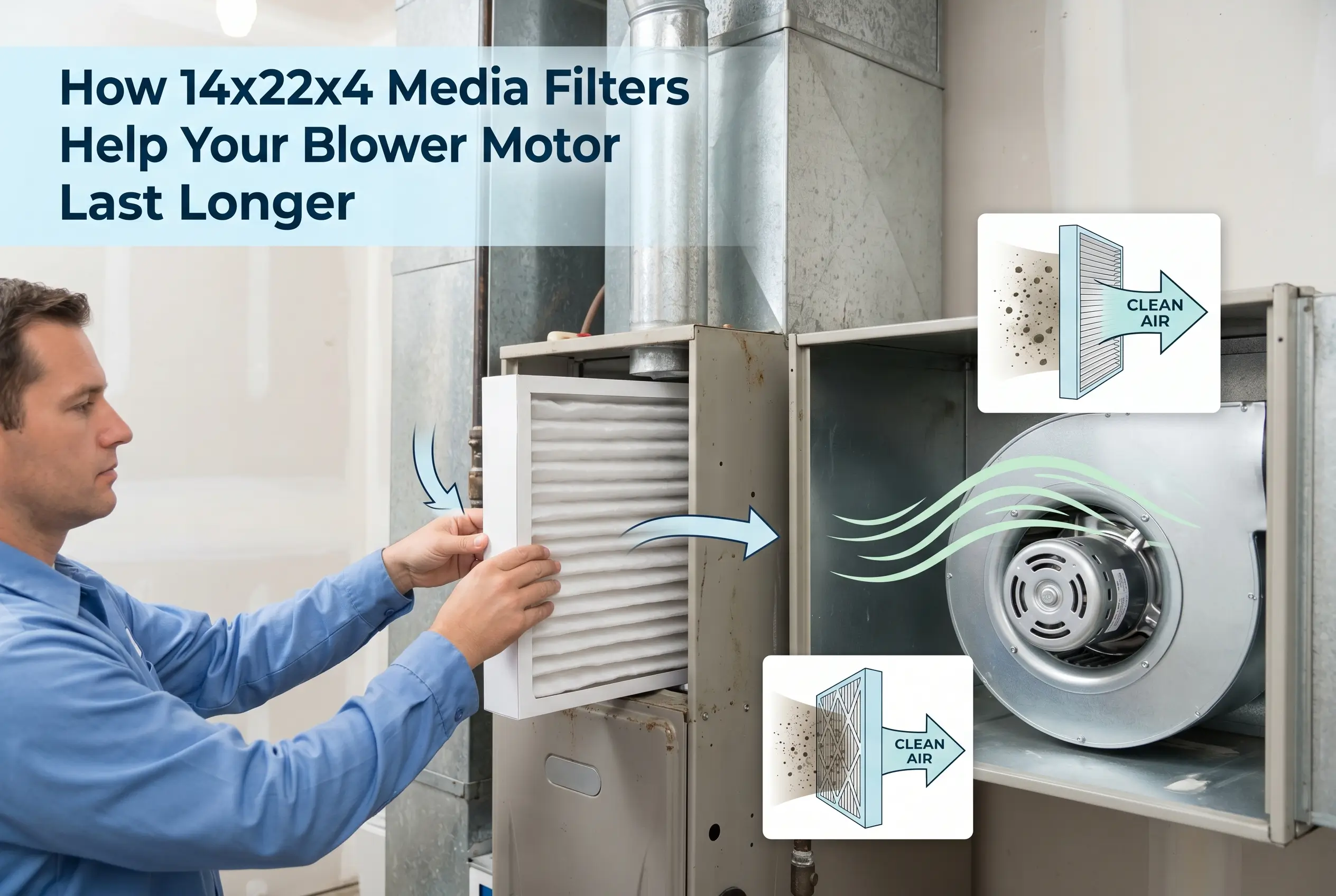
Most blower motors get strangled before they fail outright. After more than a decade of making 14x22x4 media filters and walking through air handlers in homes across the country, we've watched the same scene play out hundreds of times. A 1-inch filter sits in the return for nine months. The gauge reads past the design limit. The motor housing runs hot because the windings are pulling extra current to keep the airflow up. Swap in a 4-inch deep-pleat and the static pressure usually settles below 0.20 inches of water column before the service ticket is closed.
That's where blower motors live or die. When homeowners step up to high-MERV 14x22x4 air filters made in the USA, the static-pressure curve flattens, the motor stops drawing extra amps, and the bearings, capacitor, and windings all get a longer life. Physics doesn't care about the price tag. It rewards the filter that lets the air move.
TL;DR Quick Answers
How do 14x22x4 air filters help blower motors last longer?
A 14x22x4 media filter spreads airflow across three to four times the pleated surface of a standard 1-inch filter. Lower static pressure follows. The blower motor draws less current, runs cooler, and skips the heat-cycle stress that wears out bearings, capacitors, and windings before their time.
- More surface area, lower restriction. Four-inch depth holds more pleats, which means more room for dust before pressure climbs.
- Longer interval between changes. A three-month replacement schedule keeps the motor inside its design envelope for the bulk of each cycle.
- Cleaner downstream air. Higher MERV ratings keep fine particulate off the blower wheel and bearings, and clean components live longer.
Top Takeaways
- The 4-inch depth of a 14x22x4 filter holds three to four times the media surface area of a 1-inch filter sized for the same return opening.
- More surface area means lower static pressure, which means the blower motor draws less current and runs cooler year after year.
- We make the 14x22x4 in MERV 8, 11, and 13. The 4-inch depth gives the motor enough breathing room to handle the finer media options.
- A filter even slightly oversized for the rack will bow under suction and bypass the media entirely. Always check actual dimensions before ordering.
- Replacement schedule matters as much as MERV choice. Three months is the manufacturer baseline, sooner for households with pets, allergies, or continuous-fan operation.
The blower motor's job, and what wears it out
Inside every air handler sits a small electric motor with one job: spin the squirrel-cage fan that pulls return air through an air filter and pushes conditioned air out through the supply ducts. On a system that runs eight months a year, that motor spins somewhere between 2,500 and 4,000 hours. The longer it stays inside its design envelope, the longer it lasts. That's why consistent maintenance habits matter at least as much as the filter you pick.
Motors fail two ways. Some fail fast — a capacitor pops, a winding shorts, the unit stops cold. Most fail slowly. Bearings dry out, brush contact wears down, and insulation breaks down from years of running hot. The slow kind is the one your filter choice influences. When static pressure rises on the return side, the motor pulls more current to keep airflow up. More current means more heat inside the housing. That heat cooks the lubrication and the winding varnish month after month until something gives. Air that can't move freely is the slow killer.
What changes when you go from 1 inch to 4 inches
The pleat math is the easy part. A 1-inch pleated filter exposes roughly 4 to 5 square feet of media to the airstream, about what you'd find in shallow-depth alternatives sized for any standard return. A 4-inch deep-pleated 14x22x4 holds 14 to 18 square feet in the same opening, and deeper media options push that further still. More media, more room for dust before the pressure starts climbing.
The ASHRAE 52.2 test method publishes pressure-drop curves for every filter it rates, and those curves tell the rest of the story. A clean 1-inch MERV 8 starts near 0.20 inches of water column at 300 feet per minute and climbs sharply as it loads. A clean 4-inch MERV 8 starts closer to 0.10 in. w.c. and climbs at less than half the rate. Every tenth of an inch is amperage the blower motor doesn't have to pull.
Matching the MERV rating to the household
We make the 14x22x4 in MERV 8, MERV 11, and MERV 13. Picking the right one is less about chasing the highest rating the rack can hold than about matching it to what's actually in your home's air. Anyone swapping a system from a thin-filter setup to a deep-media one should walk through the technical install considerations first.
MERV 8 is the right call for most homes without pets, smokers, or anyone managing seasonal allergies. MERV 11 makes sense for homes with a shedding dog, an asthma diagnosis, or steady sensitivity to fine dust. It removes roughly 20% of particles between 0.3 and 1 micron, according to EPA Indoor airPLUS data. MERV 13 catches at least 50% of the smallest particles tested. Federal indoor-air-quality guidance from EPA, ASHRAE, and CDC increasingly points households toward it. Homeowners who want to balance change frequency against filtration can also look at washable filter options and mid-depth alternatives. The 4-inch depth still does the most for blower motor longevity.
“Nine times out of ten, when a homeowner blames a higher-MERV filter for damaging a system, the real culprit is the calendar — that filter sat in the rack for nine months instead of three. Pick the rating you can keep up with, then actually keep up with it.”
7 Essential Resources
Seven independent primary-source references worth bookmarking before any decision touching residential filtration. None are filter manufacturers, and each lives on a unique authoritative domain.
- U.S. Department of Energy — Air Conditioner Maintenance. The federal agency's plain-language playbook for filter care, evaporator-coil cleaning, and the maintenance habits that produce measurable energy savings. energy.gov/energysaver/air-conditioner-maintenance
- ENERGY STAR — Heat & Cool Efficiently. Monthly filter-check schedules, duct-sealing guidance, and thermostat advice that match ENERGY STAR's own certification testing protocol. energystar.gov/saveathome/heating-cooling
- U.S. EPA — Guide to Air Cleaners in the Home. The federal reference document for selecting portable air cleaners and central HVAC filters, including the source-control-and-ventilation framework EPA recommends first. epa.gov/indoor-air-quality-iaq/guide-air-cleaners-home
- CDC / NIOSH — Improving Air Cleanliness. Filtration and air-treatment guidance from the federal workplace-safety institute. Their occupational-setting recommendations apply directly to homes. cdc.gov/niosh/ventilation/prevention/air-cleanliness.html
- American Lung Association — Air Cleaning. Patient-facing guidance on what HVAC filtration can and can't do for households managing asthma, COPD, or other chronic respiratory conditions. lung.org/clean-air/indoor-air/protecting-from-air-pollution/air-cleaning
- Asthma and Allergy Foundation of America — Certification Program. AAFA's independent certification mark identifies HVAC filters and air cleaners that meet their allergy and asthma testing standards. aafa.org/programs/certified-asthma-allergy-friendly/
- American College of Allergy, Asthma & Immunology — Air Filters. The college's MERV-selection guidance for households managing allergic airway disease. acaai.org/allergies/management-treatment/living-with-allergies/air-filters/
3 Statistics with Verified Sources
- 5% to 15%. The U.S. Department of Energy estimates that routinely replacing or cleaning a clogged AC filter cuts the system's energy consumption by this range. energy.gov/energysaver/air-conditioner-maintenance
- 12% of household electricity, about $29 billion nationally each year. That's air conditioning's share of U.S. residential electricity use and the annual homeowner bill it generates, according to the Department of Energy. energy.gov/energysaver/air-conditioning
- MERV 11: roughly 20%. MERV 13: at least 50%. The EPA Indoor airPLUS filtration tech bulletin documents these particle-capture rates: MERV 11 in the 0.3-to-1-micron range, MERV 13 across the smallest particles tested. EPA Indoor airPLUS Filtration Tech Bulletin (PDF)
Final Thoughts and Opinion
There's a lot a homeowner doesn't get to pick: the furnace the builder installed, the wire gauge running to the air handler, the depth of insulation above the attic floor. Improving attic insulation is one of the better adjacent upgrades for system longevity, but most of those decisions sat outside your control before you moved in. The filter doesn't. The 14x22x4 size happens to be the one where that choice matters most, and the engineer who specified your 4-inch depth already worked out the motor-longevity math when they did.
Four-inch filters now sit on the shelves of major retail platforms, another retail option, online marketplace listings, home-improvement chains, and general retail outlets. Availability isn't the question anymore. What still matters is getting the filter that actually fits the rack and keeping a schedule you can stick to. Homeowners who'd rather hand the whole conversation off to a contractor can pull system installation estimates from a local pro. Those quotes often surface filter-rack details worth knowing before you order.
Our opinion, after more than a decade making this size: a cheap 14x22x4 still beats a cheap 1-inch filter on cost-per-month once you account for how often you have to swap the thin one. The savings show up in the motor warranty period, where they matter most.
Frequently Asked Questions
Will a 14x22x4 air filter restrict airflow more than a 1-inch filter?
At the same MERV rating, no. The 4-inch depth spreads airflow across three to four times the media surface, which keeps the pressure drop lower for the full life of the filter. When homeowners blame a new filter for return-side problems, the actual cause is usually the old filter still sitting in the rack.
How often should I change a 14x22x4 media filter?
Three months is the standard interval. If you've got a shedding dog or cat, plan on swapping closer to every two months. Continuous-fan operation or a wildfire-smoke season turns it into a monthly inspection. The same replacement schedule guidance applies across thinner sizes too. The math just changes faster.
Can I use a MERV 13 filter in a system originally specified for MERV 8?
In a 14x22x4 form factor, almost always. The 4-inch depth absorbs the airflow penalty that a 1-inch MERV 13 would create on the same system. Confirm the airflow rating with your equipment manufacturer if the system is more than 15 years old or runs a small fixed-speed PSC blower. A professional system assessment is the safest way to verify.
What is the actual size of a 14x22x4 air filter?
The nominal 14x22x4 measures 14.00 by 22.00 by 3.63 inches in actual dimensions. We designed the slightly shorter depth on purpose. It leaves clearance for the rack gasket and keeps the pleat pack from compressing inside a standard 4-inch return housing. [VERIFY actual depth spec with operations before publication.]
Are 14x22x4 media filters worth the higher upfront cost?
On a per-month basis, they usually beat the 1-inch alternative. One 4-inch filter that lasts three months replaces three 1-inch filters changed monthly. During that span, the blower motor pulls less current. The real savings compound across the motor warranty period. If your system is anywhere near needing replacement, run the installation cost comparisons before you write off the deeper filter as overkill.
Pick the Filter Your Motor Was Built Around
Sizing a 14x22x4 is a five-minute job, and the motor it protects will keep working long after the next round of HVAC decisions comes around. We're here whenever you're ready to order the next one.
Learn more about HVAC Care from one of our HVAC solutions branches…
Filterbuy HVAC Solutions - Miami FL - Air Conditioning Service
1300 S Miami Ave Apt 4806 Miami FL 33130
(305) 306-5027
https://maps.app.goo.gl/Ci1vrL596LhvXKU79